
Solar Imaging
*** Looking at the sun can be incredibly dangerous and could lead to permanent blindness**
**** Do not attempt it without proper advice and the correct filters. If you're unsure STOP & Contact Us ****
The Sun is the one astronomical object we can observe in the middle of the day — and it is far from boring. We are currently approaching Solar Maximum in Cycle 25, making this one of the best times in a decade to image it. Different filters unlock completely different layers of the Sun's atmosphere, each revealing features invisible to the others.
 |
White Light The entry point for solar imaging and the most affordable place to start. A white light filter — typically Baader AstroSolar safety film — blocks 99.999% of sunlight to reveal the Sun's photosphere. You'll see sunspots, the granular texture of the solar surface, and bright faculae around active regions. The film costs around £20 for an A4 sheet and can be made into a DIY filter housing with cardboard and tape. A Herschel Wedge offers superior quality for refractor users. Always fit the filter to the front of the telescope — never the eyepiece end. What you'll see: Sunspots, granulation, faculae, limb darkening. Good for: Beginners; any telescope type; low cost |
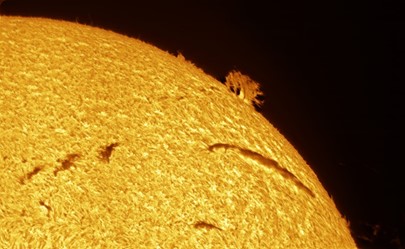 |
Hydrogen Alpha (Hα) Where solar imaging becomes truly spectacular. Ha filters are tuned to 656.28nm — the wavelength emitted by hydrogen gas in the Sun's chromosphere — revealing features completely invisible in white light. Prominences arch dramatically from the solar limb, dark filaments snake across the disc, and bright plages surround active regions. Features can change noticeably within minutes. Dedicated Ha telescopes from Coronado and Lunt are the most convenient route, with the Coronado PST a popular entry-level choice. The DayStar Quark fits a refractor. A monochrome camera gives best results. What you'll see: Prominences, filaments, flares, plages, chromospheric detail. Good for: The wow factor; dynamic, fast-changing features.
|
 |
Calcium K (CaK) What you'll see: Chromospheric network, plages, supergranulation, magnetic active regions. Good for: Experienced imagers; monochrome cameras.
|
 |
Magnesium (Mg) What you'll see: Inter-atmospheric detail, magnetised regions, plages, filament outlines. Good for: Advanced imagers wanting to go beyond Ha. |
Want to get started?
Several of our members image the Sun regularly and are happy to share their techniques, show you their equipment, and help you get your first solar image safely. Come along to a meeting.
Members can find detailed tutorials and image galleries in the Members' Section.